The Nike Free 5.0 is the successor for the Free Run 3. This was my first time running in the Free/Free Run, and so I was excited by the opportunity to review the Free 5.0.
And while this shoe is often marketed as “minimalist,” I felt it could easily serve as a daily trainer for the biomechanically efficient runner.
Nike Free 5.0 First Impressions
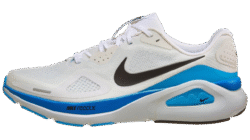
My pair of Free 5.0 comes in bright blue and florescent yellow, making a striking impression out of the box. My immediate impression is that the shoe retains the lower of the Free Run 3 while introducing updates in the upper. The most obvious upper update is the introduction of Dynamic Flywire in the midfoot lacing system.
As expected, the Free 5.0 is very unstructured and flexible. I can roll the shoe up into a ball, and twist it almost completely around. Of course, no one’s foot bends that much, but it does mean the shoe will not provide any structure for a flexible foot. The heel counter is also very flexible and unstructured, relying on an overlay that looks like the strap of a Huarache sandal to hold the heel down.
The one drawback to the shoe is that it is not true to size. Comparing it with other shoes of the same size, the Free 5.0 looks like it runs at least a full size, and maybe even a full size and a half, shorter.


I thought maybe Nike intentionally made the Free 5.0 shorter to allow someone to run in them without socks. So, I did one run sockless, but because the upper is not seamless enough, I ended up with blisters. For me, the sizing of the Free 5.0 is simply bewildering.
If you are considering the Free 5.0, I strongly recommend trying them on, to find your proper size.
Nike Free 5.0 Sole Unit
Since the Free 5.0 is marketed as a “minimalist” shoe, I fully expected to only do shorter runs in them. But I was surprised by how much cushion the Free 5.0 packs. It felt much more cushioned than either the Karhu Flow Trainer or the Skechers GoRun.
If I had to compare the cushion to any of the shoes I’ve run in, I would choose the Mizuno Precision before I would choose either of the minimalist shoes I’ve tried.
In fact, if it weren’t for the minimalist marketing that comes with it, the Free 5.0 could easily pass as a flexible lightweight trainer. If the pair I received were not too small, I definitely would have gone on longer runs in the Free 5.0.
There is of course an upside as well as a downside to this amount of cushion. The upside is the Free 5.0 will appeal to a wider audience of runners. Runners looking to move to a more minimalist shoe can use the Free 5.0 as a transition shoe. This may be especially appealing for runners who don’t want a midsole feature designed to promote a midfoot strike, like the ones found in both Karhu and Sketchers.
Biomechanically efficient runners who are looking for a flexible trainer with a lower heel-to-toe differential (it is 9mm on the Free 5.0), but not the minimalist experience per se, can turn to the Free 5.0.
The downside is runners looking for that barefoot experience will find the Free 5.0 too cushioned for their purposes. Nike puts their Phylon EVA foam in the midsole, which gives the Free 5.0 a much firmer feel than Nike’s other shoes with Cushlon in the midsole, like the Pegasus or Vomero, but that firmness may not be enough to give minimalist runners the ground feedback they seek.
Nike Free 5.0 Upper
The Free 5.0 has a newly designed upper, which resulted in a slight weight savings (size 9 is listed at 8.2 oz). But more important than a marginal weight savings is the great overall fit found in the Free 5.0. The Dynamic Flywire in the midfoot created a secure fit without being too restrictive.
The one element of the upper I had concerns about was the Huarache style heel counter. But once the shoe was on, my heel felt secure, and I never experienced heel-slippage while running. As great as the upper is in terms of security of fit, it is not seamless enough to be worn without socks.
Nike Free 5.0 Opinion
The Free 5.0 beat my expectations in many ways. I definitely was not expecting it to be as well cushioned as it is. For the right runner, this is a shoe that could be worn everyday. I also appreciate that Nike promotes a midfoot strike with a lowered heel and flexibility instead of using a gimmick.
My one complaint is that the Free 5.0 does not come true to size. If I had a properly sized pair, I easily would have run more in the Free 5.0.
We thank the nice people at Nike for sending us a pair of Free 5.0 to test. This did not influence the outcome of the review, written after running more than 50 miles in them.
Nike Free 5.0 Price Comparison
This page contains affiliate links. As an Amazon Associate I earn from qualifying purchases.