In the past two years, practically everyone in the running community has read about, heard news of, or tried a shoe marketed as “minimalist” by its manufacturer. However, the term “minimal” in regard to running footwear has become one of those very loosely defined phrases that has been brandished about somewhat irresponsibly by many shoe manufacturers trying to jump on the bandwagon. That stated, the purpose of this article will be to provide a concrete definition of what constitutes a minimalist shoe, how runners at all levels can safely employ the use of this type of footwear, and how you can wade through the myriad information out there about minimalism to make you a more informed buyer.
Minimalist Myth Busting
First, let us attempt to clarify, explain in further detail, or debunk several common myths about minimalist running shoes.
Myth #1- Minimalist shoes improve your form.
Fact: Minimalist shoes can indeed help one improve their running form, but it is more a conscious bi-product of running in these shoes frequently rather than the shoes themselves. Because of their sparse construction, runners tend to strike the ground lighter, push-off more efficiently, and land more towards the forefoot with each stride in a minimalist trainer. These changes can be made permanent overtime as the body retrains its biomechanics, and if one were to put back on their old clodhoppers after wearing minimal shoes, their form would remain improved. So, point being, do not buy a pair of minimal trainers and expect your form to improve overnight. Such modifications take time and effort, just as all worthwhile pursuits in life.
Myth #2- Running long distances in minimal shoes will injure you.
Fact: This assumption is false, provided the runner allows his or her body time to adapt to less cushioning and material underfoot. Because minimal shoes will gradually improve one’s form in a matter of weeks, minimal shoes can actually decrease injury risk in well-trained runners. However, as stated before, it is imperative that one gradually increase their time spent in minimalist trainers from something akin to two-miles on grass in the lesser shoe in week one, to five miles easy on the road in minimalist shoes in week four.
Fact: This is a highly debatable assumption, much the same as some nutritional supplements, training techniques, or therapeutic aids, but the truth of the matter is that shoes alone will not make you faster. One must still log the appropriate volume, run at the right intensities, and put in the necessary work each week to increase their fitness level progressively over time.
Fact: This statement is largely a false assumption. While lithe runners with perfectly neutral gaits will require less time to adjust to the lower profile of a minimalist shoe, they are not the only ones who should give less shoe a trial run (pun intended). The beauty of true minimal trainers is that no matter your pronation pattern, body weight, or gait abnormalities, judicious (albeit cautious) use of minimal trainers will help to correct these flaws over time by forcing your body to run more efficiently. Heavy trainers with stability features “prevent” your feet from doing what they “want” to do, but minimal trainers allow your body to work out its own kinks and find the right stride for you as an individual.
Fact: While Nike was one of the first brands to adopt a minimal shoe into their line in the early 2000s, the boom in minimal running has become profound in the past two years. Every major shoe manufacturer has something to offer at present by way of minimalism, but some are going to be more purist than others. As a new minimalist buyer, I recommend that one look for a brand line-up that allows the runner to transition gradually from one minimalist shoe to the next without jumping all-in to minimalism as a whole. Below are some great choices available today.
The Puma FAAS series includes six shoes in total from a highly cushioned mid-weight trainer with the FAAS 550, to a very low-profile minimal shoe with the FAAS 200. Below is the
Faas 250, one of their lightest options.
Saucony’s minimal line-up ranges from the plush Mirage (top shoe below), to the critically-acclaimed Kinvara (bottom shoe below), and then down to the barely-there Hattori, allowing a runner interested in minimalism to advance as they like downward through their collection.
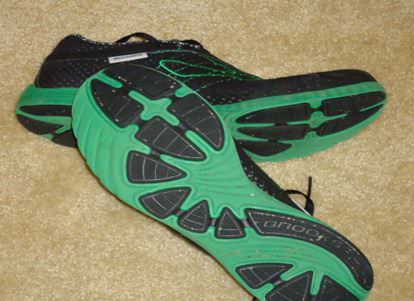
The new Brooks Pure line of trainers which just hit the market last fall does much the same as the above. They have a lightweight stability shoe in the Cadence, to a minimal neutral trainer in the Flow, to practically an extension of your foot in the Connect. Also with Brooks, there is the Green Silence which incorporates eco-friendly biodegradable materials into a minimalist design (below).
Minimalism Defined
With several common minimalist myths explained, let us now look at what such a shoe truly is so you as a potential buyer will know what to look for in stores. In the purest sense of the word, and as a runner who uses such footwear daily, minimalist running shoes must fit the criteria of the following categories to truly be what they claim to be.
A big tenant of minimal shoes at present is a “zero-drop” heel to toe ratio. This means that there is no difference in height between a shoe’s heel and its furthest point on the toe, thereby separating it from more traditional training shoes that have raised heel cups. While zero-drop isn’t necessary for a shoe to be minimal, it does need to have a heel to toe ratio of less than 10mm.
Now that we have dissected the minimal trend to more practical components, it is up to you to decide whether minimal shoes are right for you. I would recommend giving a pair an honest try, using them as a training tool at first, and progressing along with them as you see fit each week. You may find that they are just what you have been looking for in a shoe, or you may find yourself going back to the old, tried-and-true clodhoppers that have always been your personal stand-by in times of running shoe evolution.


Had to chime in, the weight thing is absolutely true. In fact large runners may even have more to gain from a more efficient gate. I’m 5-10 200 lbs, I might hit 180 if I stopped all attempts at not starving. So I’m not your average skinny. After a couple years doing marathons I started to have knee pain which I have solved by changing up my
form including work in mjnimalist shoes.
I belive one of the major factors in my development of pain was my size and had I been lighter, the defect in my knee might not have developed.
Basically I believe that while the elite guys can benefit from running better because of the volume they subject themselves too, slower heavier runners can benefit in being able to manage impact better. I have at least.
By the time I got accustomed to running huarache sandals I was running a full minute pace faster than before with no extra effort. This is probably the case where a person had really bad form and the improvement in form lead to more efficient running.
“Trainers? Let me tell you what’s worse than a pair of running trainers — minimalist running trainers!”
There is no data or research to back up this article. There is no research that states that Minimalist running shoes or landing on your forefoot is better for you. I have yet to read anything from the medical community that proves otherwise.
Ok, well here’s a Harvard-conducted medical study.
http://barefootrunning.fas.harvard.edu/
Have fun learning. Only a simple search with the terms “minimalist running study biomechanics” from google would bring up thousands of studies by medical universities across the world.
Google. It’s this great new invention. You should try it out sometime.
Nice
“Google. It’s this great new invention. You should try it out sometime.” – Spot On!!!
LOL. Some research!
“FUNDING DISCLAIMER: Research presented on this site was funded by Harvard University and, in part, by Vibram USA®.”
…So to be clear, it was a Harvard/VIBRAM-conducted medical study.
I would say that the paper’s acceptance by “Nature” weighs more heavily on its credibility than any partial funding by Vibram USA. Note that the paper (if you read it) only claims to document the mechanics and hypothesizes about a link to injury. It does not draw a conclusion on the latter. It simply says barefoot people run differently and experience lower impact forces even without the modern cushy soles.
Read born to run
Here’s another for ya http://www.sciencedaily.com/releases/2010/01/100104122310.htm
Yeah, you’re kinda behind the times there, VA.
It doesn’t take much more than common sense to know that when you land on the heel of your foot and knee extended strait, like most people who have bad form from running in the old school huge heel support shoes, that it’s bad on every joint head to toe. running on the forefoot causes a spring effect. trying jumping up and landing on strait legs and on your heels a few times and see how it feels, thats the same exact thing that happens when you have improper form and heel strike. All they are trying to say is that these type of shoes HELP you get better form. They don’t just turn into you into a magical marathon runner, you do the work to perfect it all. It’s easy to see how bad supported shoes are. The biggest way is that it causes most people to run with bad form and it makes your feet depend on the support instead of building natural strength and support in those little muscles you hardly use cause of those shoes. Since wearing minimalist and barefoot shoes my balance has improved drastically. My calves used to never get sore no matter how long I ran. Minimalist(not barefoot) shoes smoke my calves almost ever run to this day and I’ve worn them for almost three years.
Just cause you dont want to take the time to make yourself a better runner doesnt mean you get to complain about these shoes having “no evidence”. It’s out there, look for it yourself and stop making other people do it for you.
Wrong myths has been practised about minimal running shoes. Minimal running shoes will injure, it will make you faster, etc are the myths to be thrown away from peoples mind. Shoes alone don’t valuate your speed, it also depends on the player.
If one looks at the laws of physics it is understood that the heavier the runner, the more cushioning needed to protect against shock. Most injuries are the result of running on concrete with shoes that offer little cushioning. Anyone who believes the opposite of this has not run in a heavy frame on hard surface day after day. The minimalist movement is just a marketing gimmick that will fade out one day and we will then see articles about the importance of adequate cushioning materials to absorb shock. Runners need to think for themselves and not allow a marketing manager to brainwash one to not think logically!
Heavy or light running with the correct form is the key. Thick cushioning shoes promote a heavy heal strike. The human body is not designed to run on it’s heals. Mid foot is the way to go because the cushioning comes from your calf muscles. Try running bare foot and look at your form. Minimal shoes help promote the correct form but it is still up to you.
Sorry but myth #2 is accurate.
from personal experience i have been running minimal for 2 years and anything over 13 miles I start to feel the hurt.
it’s just physics- that much pounding of your feet against road for that much time will hurt you (if not injure you).
I would not recommend running a marathon in minimalist shoes as your form breaks down after running that long and you will not be as lithe at mile 18 as when you started.
I love running marathons but I agree that running that distance is not “natural” and running them with little to no protection, less so.
and yes there are always some outliers who can do it barefoot or in Vibrams, but that is not the norm.
This below text was taken from the Harvard Study concerning heels strikes and injuries vs. landing on the forefoot.. That being said, I need a new pair of shoes and Im thinking of “doing it.” My Nimbus may take a back seat. Im afraid of injury though and I know that I am a natural heel striker..Got to teach a dog new tricks..
“Not necessarily! Many people like to run this way and do so without injury. But some runners get repetitive stress injuries each year (estimates vary from 30-75%) and one hypothesis is that heel striking contributes to some of these injuries. We emphasize though, that no study has shown that heel striking contributes more to injury than forefoot striking. Read on to learn more about forefoot striking.”
Yes, I agree. A gentle heel-strike can be just as effective as a mid-foot strike in preventing injuries. I have found that running with the “knee soft” and landing within two inches of your center of gravity is just as effective (if not more so) than trying to mid-foot strike in keeping injury risk low. This biomechanical trait is also easier to train- just engage the core, increase stride-rate, and shorten stride length. Running uphill at faster speeds is great to improve form and dynamically strengthen muscles, as most runners have known for a long time.
1. Maybe the cushioning is marketing?
2. Imo Harvard U could get more money from eg Nike
3. Why dotn u try it and get it back?
I found minimalist, barefoot, natural running through injury. I could not run the distances I wanted on a day to day basis without pain. Mainly shin, knee and hip pain when my mileage increased. I was led down the medical, podiatry, gait analysis and foot strike route which immediately prescribed me motion control shoes and full length bespoke orthotic insoles with heel cups, massively built up arches and metatarsal domes. Why? Because I was a 200lb plus, flat footed, heel striking, shire horse of a man who should know better than to try and run more than a mile on the roads. Any way, I was told to go out and train in these new feet gradually at first and build up slowly. It took me approximately 200 yards to realize that this was wrong. The feeling was excruciating. I never wore these shoes/insoles again. Something told me that I had to change the way I ran which led me to the internet, research, the Pose method and other such sites and theories. The result is that about 6 years later I am running in what you might call minimalist shoes or racing flats for all my training and races up to marathon distance. I don’t believe the hype when buying shoes and believe that it is mainly about your biomechanics. The main problem with stability or motion control shoes is they hinder a fore/mid foot strike with their high heels and don’t allow your foot, calves, hamstrings to do their job efficiently. My feet and legs are massively strong now compared to what they were and I always say to the doubters, “if you were barefoot, how would you run across that concrete car park?” You wouldn’t do it heel striking for long but thats what I did when I went to the podiatrist, heel planted onto the foot scanner, put my trainers on and heel planted my way down the treadmill for 5 minutes. The diagnosis should have been, go away and learn how to run more efficiently. Sorry for the long post, but I am passionate about this.
Andy, I am having the same problems u had, and I think about buying minimalist shoes such as Brooks pureflow any advice ?
btw
I am flat footed + Internal collapse.
Thank, Shai
Myth no.3??? I run barefoot, or in minimalist shoes. Barefoot certainly makes me slower – but I don’t mind at all. I’m not competing, I’m running for its own sake; how fast I go is of little interest.